Content
Use this guide to understand general information about ACH lifecycle.
1. ACH lifecycle overview
2. Key considerations
2.1. Key concepts
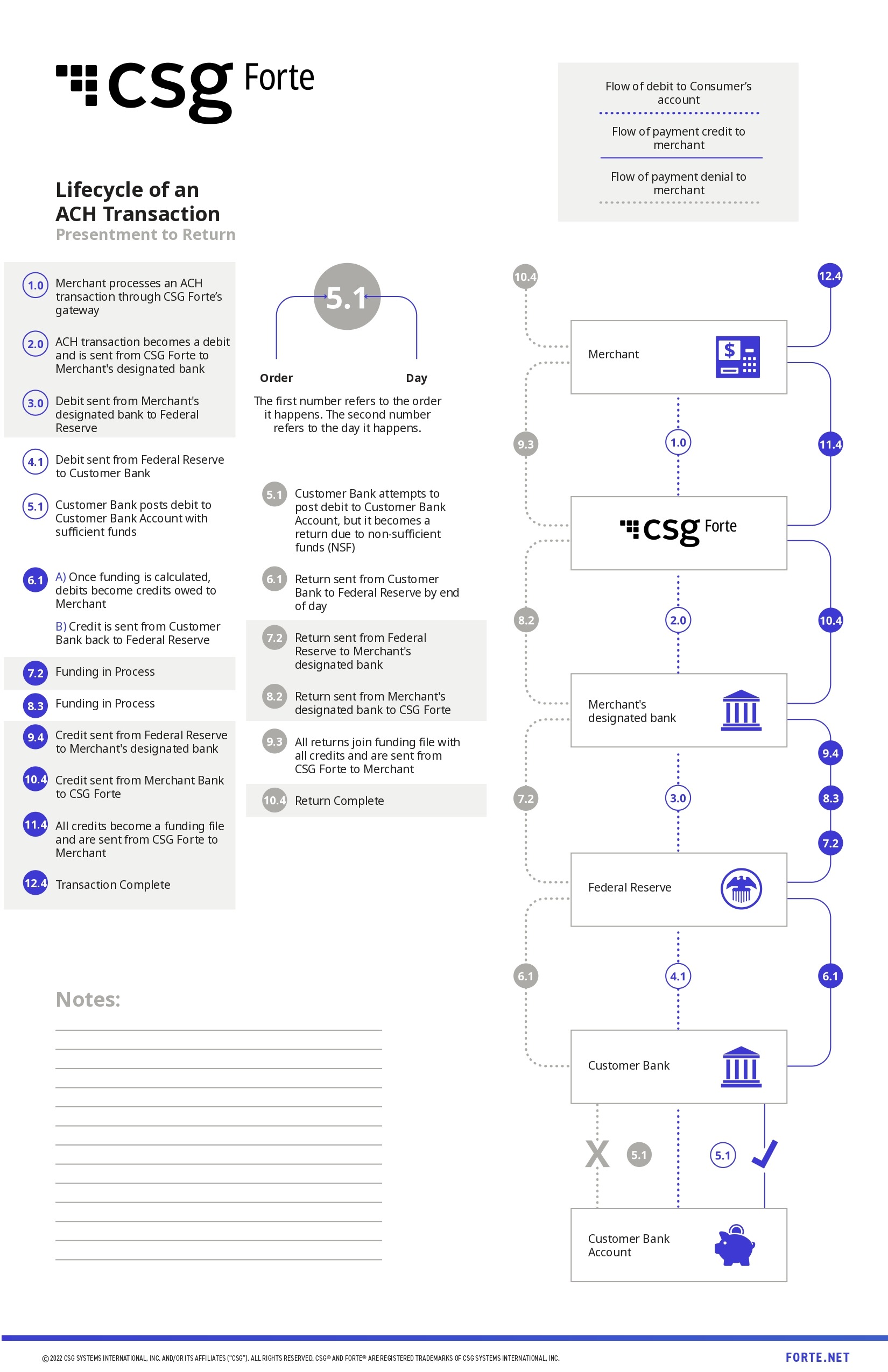
3. ACH Payment lifecycle
4. Key characteristics
5. Key operational risk
6. ACH cutoff times
7. Additional related resources
1. ACH Lifecycle Overview |
The Automated Clearing House (ACH) is an electronic network used to transfer funds between bank accounts, commonly supporting direct deposits, bill payments, and bank-to-bank transfers. Unlike card payments, ACH transactions are processed in batches rather than in real time, which directly shapes the transaction lifecycle and affects settlement timelines and fund availability.
The ACH transaction lifecycle begins when an originator initiates a payment instruction through their financial institution, known as the Originating Depository Financial Institution (ODFI). The ODFI validates the transaction details and submits the entry in a batch to the ACH network operator at scheduled intervals. The ACH operator then sorts and distributes the transactions to the appropriate Receiving Depository Financial Institutions (RDFIs). Upon receipt, the RDFI posts the transaction to the receiver’s account, either debiting or crediting funds, based on the entry type. The RDFI may accept, return, or reject the transaction within defined timeframes if issues arise (such as insufficient funds or authorization problems). Finally, settlement occurs between financial institutions through designated settlement accounts, completing the process, while any returns or exceptions are handled in subsequent processing windows.
2. Key Considerations |
|
|
Beyond the core process flow, the ACH lifecycle is governed by a set of operational, timing, and compliance considerations that are essential for effective management. ACH transactions follow standardized formats and classification codes (e.g., SEC codes), which define the nature of the payment and establish corresponding authorization and processing requirements. Proper authorization is mandatory, and originators are responsible for obtaining and retaining valid consent in accordance with applicable rules.
Processing occurs in designated batch windows, including same-day ACH options, which influence both settlement timing and funds availability; however, these do not provide real-time finality. As a result, there is a distinction between when funds are made available to the receiver and when interbank settlement is fully completed.
Additionally, ACH transactions are subject to a structured return and exception framework, with defined return codes and timeframes, typically within two banking days for most returns, and up to 60 days for unauthorized consumer transactions. This extended return period introduces ongoing exposure and necessitates effective monitoring.
Participants must also adhere to established network rules (such as those set by Nacha), maintain acceptable return rates, and implement appropriate risk management and fraud prevention controls to ensure compliance and operational integrity.
KEY CONCEPTS:
- Settlement and funding mechanics are key. ACH transactions are settled through designated settlement accounts (typically held at central banks or correspondent institutions), and participants must ensure they maintain sufficient prefunding or liquidity to meet obligations. Failures at this stage can result in delays or rejected batches, even if the transaction itself was vali
- ACH credits vs. debits behave differently and carry different risk profiles. Credits (e.g., payroll) are generally considered lower risk because the sender is pushing funds, whereas debits (e.g., bill payments) pull funds from a receiver’s account and therefore require stricter authorization controls and are more prone to returns and dispute
- Cutoff times and processing schedules vary by institution and ACH operator. Missing a cutoff time can delay processing by one or more business days, which is particularly important for time-sensitive payments like payroll or bill due dates. This makes scheduling and file submission timing a critical operational consideration.
- Reversals and corrections are possible but limited. Erroneous transactions can be reversed under specific conditions (e.g., duplicate or incorrect amounts), but strict timeframes and rules apply. Not all transactions are eligible for reversal, and improper use can create compliance issue.
- Notifications and addenda data provide additional context within ACH entries. Addenda records can carry remittance information, which is especially important for business payments and reconciliation processes. Proper use of this data improves downstream accounting and reduces manual intervention.
3. ACH Payment Lifecycle |
|
|
Day | Action | Status |
Monday (Day 0) | Merchant submits ACH debit file before cutoff | The ACH file is submitted to the ODFI and sent to the ACH network during the evening processing window. |
Tuesday (Day 1) | Customer’s bank debits the account | The RDFI posts the debit, and the customer typically sees the funds withdrawn from their bank account. |
Wednesday–Friday (Days 2–4) | Risk review / funding hold period | The transaction is subject to standard risk checks, fraud monitoring, and any applicable funding hold policies. |
Following Monday (Day 5) | Funds released to the merchant | If the merchant is on a standard 4-day hold, funds are deposited into the merchant’s bank account. |
4. Key Characteristics |
|
|
Processing Timeframes | ● Standard processing: 1–5 business days ● Same Day ACH may be available depending on submission timing ● Weekends and bank holidays are excluded ● ACH settlement may take up to 6 business days in cases involving risk review, reserve policies, manual verification, or fraud monitoring. ● Factors that may extend settlement time include: ○ Merchant risk category ○ High-volume or high-ticket processing ○ Underwriting review ○ Manual fraud checks ● Only business days count toward the timeline; weekends and bank holidays are excluded. Note: Customer account debits and merchant funding do not occur simultaneously. Funds may be debited from the customer’s account before they are released to the merchant, depending on funding hold policies and risk review outcomes. | ||
Transaction Types | Type | Name | Description |
20 | SALE (Debit) | Charges the customer’s account. Funds are withdrawn and processed. | |
21 | AUTH ONLY | Authorizes the payment but does not transfer funds. Requires a CAPTURE. | |
22 | CAPTURE | Completes a previously authorized transaction (AUTH ONLY). | |
23 | CREDIT (Refund or payout) | Refunds or sends funds to the customer’s account. | |
24 | VOID | Cancel a transaction before it has been settled. | |
25* | FORCE | Charges the customer without validation checks. Often used in emergencies. | |
26* | VERIFY ONLY | Verifies account information without charging the customer. | |
Note: Transaction types 25 and 26 are only available if the merchant account has verification services enabled. | |||
Transaction Statuses | Status | Meaning | |
Ready | Transaction is approved and ready to be processed. | ||
Settling | Funds are being transferred (sent to the Receiving Depository Bank). | ||
Funded | Transaction completed successfully and funds have been released. | ||
Rejected | Transaction failed. The R code indicates the return reason from the bank. | ||
Unfunded | Transaction was previously funded but has now been returned or disputed. | ||
Note: An approved ACH transaction means it’s eligible for origination, not necessarily that funds have been transferred. Only after the customer’s bank processes it will the transaction be marked as Funded or Rejected | |||
5. Key Operational Risk |
|
|
Processing Nature | ● Batch-based processing model ● Dependent on financial institutions: ○ ODFI (Originating Depository Financial Institution): the bank that initiates the ACH transaction on behalf of the merchant ● Subject to cutoff times and bank schedules○ RDFI (Receiving Depository Financial Institution): the bank that receives the ACH transaction and posts it to the customer’s account |
Returns and Disputes | ● Transactions may be returned within 2–60 days, depending on the reason ● Customers have up to 60 days to dispute transactions ● Proof of Authorization (POA) is required for dispute validation |
Risk Factors | ● Funds are not guaranteed at the time of submission ● Higher exposure to delayed returns ● Dependency on accurate bank account validation |
| Risk & Settlement Delays | ● Settlement may be delayed due to additional fraud checks, reserve policies, validation requirements, or merchant risk flags. ● These delays affect the release of funds, not the origination of the transaction. |
6. ACH Cutoff Times |
|
|
ACH cutoff times determine whether a transaction is processed on the same business day or deferred to the next processing cycle. CAD and USA ACH cutoff times are the same, but they can vary depending on the day the transaction is made. For same-day ACH transactions, the cutoff time is 9:30 AM PST.
Period of week | Cutoff time |
Monday to Sunday (except on bank holidays) | 6:30 PM PST |
Note: Same Day ACH processing is only available for merchants that are explicitly enabled for this feature. Most merchants are not configured for Same Day ACH by default. If a merchant is not set up for Same Day ACH, transactions submitted after the standard cutoff will be processed in the next available business day window.
7. Additional Related Resources |
|
|
Topic | Context |
Overview of ACH funding timelines, including processing stages, transaction review hold periods, funding holds, settlement timing, and available faster funding options. | |
Reference for invoice billing descriptions and product codes used in merchant payments, supporting accurate interpretation of billing and transaction codes for consistent financial reporting across supported payment types. | |
A request to raise the approved ACH processing or funding limits for a merchant account. Limit increases are evaluated based on risk, transaction history, and funding exposure. | |
Overview of transaction and verification codes used in CSG Forte payment processing, including status, response, return, settlement, AVS, and CVV codes. | |
This FAQ explains cutoff times for ACH and credit card transactions, including how they affect processing, settlement, returns, and funding timelines. It also covers processor-specific cutoffs, same-day ACH, midnight cutoff options, and expected funding delays. | |
Proof of Authorization (POA) | Documentation that confirms the customer authorized the ACH transaction. Proof of Authorization may be required to support ACH funding in cases of disputes, returns, or compliance reviews. Note: Requests outcomes are determined by the requesting banks and applicable payment networks. CSG Forte acts only as an operational intermediary and does not control or make final decisions regarding their resolutions. |
Was this article helpful?
That’s Great!
Thank you for your feedback
Sorry! We couldn't be helpful
Thank you for your feedback
Feedback sent
We appreciate your effort and will try to fix the article