Questions
1. What does PP.ai mean?
1.1.1. Why is traditional fraud prevention not enough anymore?
1.1.2. How does PP.ai help businesses fight evolving payment fraud?
1.1.3. How does PP.ai reduce fraud without impacting customers?
1.1.4. What types of fraud and risk does PP.ai help detect?
1.1.5. How does PP.ai work?
1.1.6. How does PP.ai make fraud decisions and handle alerts?
1.2. Does PP.ai replace other CSG Forte fraud or validation tools?
1.2.1. How do these products work together?
1.2.2. What are the key differences in their capabilities?
1.3. Does PP.ai guarantee compliance with nacha rules?
1.4. How is PP.ai priced?
1.5. How will PP.ai charges be reflected on the monthly billing statement?
1.6. How do I know if I am eligible for activation?
1.7. Who can be contacted for additional information or clarification?
1.7.1. What information needs to be provided?
1.8. Where can customers find PP.ai terms and information?
1. What does PP.ai mean? |
Payments Protection (PP.ai) is an AI‑powered fraud detection and risk‑management service designed to monitor ACH and card payment activity over time and help identify unusual or potentially suspicious behavior. PP.ai supports merchants’ fraud‑monitoring efforts and helps align with ACH risk‑based monitoring and compliance expectations, including Nacha requirements.
1.1.1. Why is traditional fraud prevention not enough anymore? |
|
|
Payment fraud is evolving rapidly, with attackers using more sophisticated and adaptive techniques. Many traditional fraud tools are limited by narrow payment coverage, static rules, and poor adaptability, making it harder to detect modern fraud without increasing false positives or customer friction.
1.1.2. How does PP.ai help businesses fight evolving payment fraud? |
|
|
PP.ai uses AI powered, continuously adapting monitoring to analyze ACH, card, and digital payments transaction behavior across online, phone, and in‑person payment channels. By detecting suspicious patterns in near real time, it helps businesses identify fraud earlier while keeping legitimate transactions flowing smoothly.
1.1.3. How does PP.ai reduce fraud without impacting customers? |
|
|
PP.ai is designed to stop fraud—not business. Using enterprise‑class AI and finely tuned accuracy, the platform identifies suspicious transactions at scale and routes them for intelligent decisioning. The solution combines industry tuned intelligence and intelligent decisioning to detect fraud while minimizing false positives. This balanced approach reduces fraud losses and compliance risk without unnecessarily declining valid customer transactions or adding operational friction.
1.1.4. What types of fraud and risk does PP.ai help detect? |
|
|
PP.ai focuses on both common and advanced payment fraud and risk patterns across ACH, card, and digital transactions. This includes payment and refund abuse, customer payment fraud, card testing activity, account takeover (ATO), merchant bust‑out behavior, credit stress indicators, and unusual fund movement patterns that may signal AML‑type risk. By continuously monitoring transaction behavior across all covered payments, PP.ai helps surface these risk patterns early, so businesses can act before losses, compliance exposure, or operational impact increases.
1.1.5. How does PP.ai work? |
|
|
PP.ai works by analyzing every covered transaction in near real time, giving a complete view of payment activity across your business. Transactions first flow into the platform as inputs, where AI/ML models and configurable risk rules analyze behavior based on the client’s unique risk profile, recognizing that high‑risk patterns can look different from one merchant to another. Based on the resulting risk score, PP.ai applies client‑defined thresholds to automatically approve low‑risk transactions, flag higher‑risk activity, or generate alerts for review. As more transactions are processed, the system continuously learns and improves, becoming increasingly effective at distinguishing legitimate payments from fraud over time.

1.1.6. How does PP.ai make fraud decisions and handle alerts? |
|
|
PP.ai works with each client to define risk thresholds based on their risk appetite. Using those thresholds, PP.ai automatically acts on transactions in near real time:
Transaction Risk | PP.ai Response | Reason |
Low | Automatically approved. | Keeps payments fast and friction‑free for legitimate customers. |
Medium/Uncertain | Flagged and sent as an alert for review. | Helps prevent fraud losses before funds move. |
High | Declined or voided (before settlement cut‑off where possible). | Enables manual review by risk analysts as part of managed risk service. |
1.2. Does PP.ai replace other CSG Forte fraud or validation tools? |
|
|
No. PP.ai does not replace existing validation or authentication tools. It adds an additional layer of behavioral monitoring that analyzes transaction activity over time to help identify unusual or potentially suspicious patterns.
Product Overview | |||
Product | Overview | Protection Covered | Applicability |
Validate | Checks if the account is real, open, and correctly routed before payment. | ACH | Pre-Auth |
Validate+ | All Validate checks plus bad check history, stop payments, and 1.5B external records. | ACH | Pre-Auth |
Authenticate | Verifies who own the bank account before ACH credit transactions are processed. | ACH credits | Pre-Auth |
PP.ai | Detects fraud patterns and suspicious activity across ACH and card in near real-time. | ACH + Card + Wallets | Near real-time |
1.2.1. How do these products work together? |
|
|
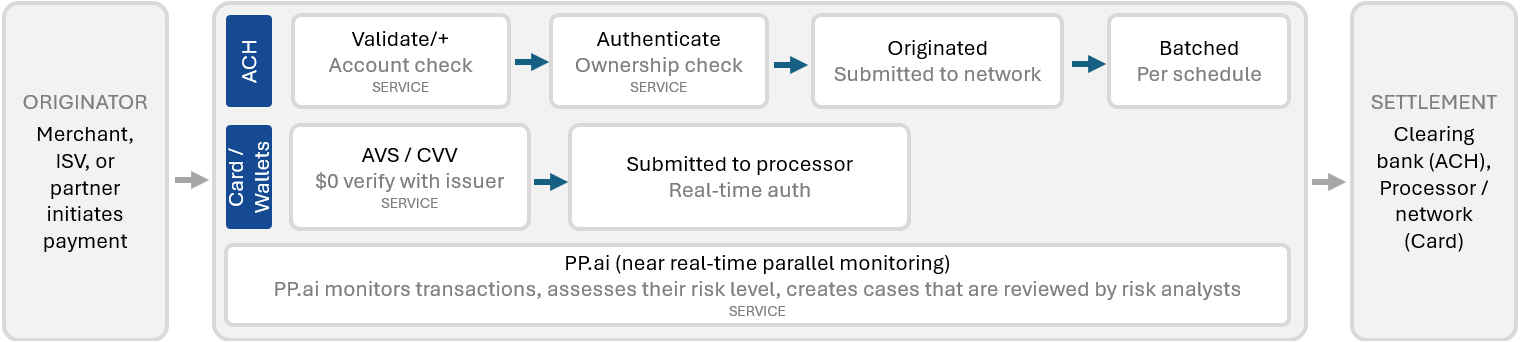
1.2.2. What are the key differences in their capabilities? |
|
|
Capability | Details | Validate | Validate + | Authenticate | PP.ai |
Account verification | Account holder name verification |
|
| X |
|
Routing number and account validation | X | X | X |
| |
Enhanced risk assessment | Decision codes at payment presentment |
| X |
|
|
Bad check history, stop payments, account age |
| X |
|
| |
Fraud detection and monitoring | AI/ML-powered fraud scoring and detection |
|
|
| X |
Cross-channel monitoring (ACH + card) |
|
|
| X | |
Account takeover, merchant fraud, card testing |
|
|
| X | |
Transaction velocity and anomaly detection |
|
|
| X | |
Data sources and service model | Account ownership database (596M+ records) |
|
| X |
|
Internal routing and account database | X | X |
|
| |
External financial and retail database (1.5B records) |
| X |
|
| |
Managed service with CSG analyst support |
|
|
| X |
Note: For Nacha 2026 compliance readiness Authenticate (account ownership verification on ACH credit transactions) and PP.ai (commercially reasonable fraud monitoring and detection) are recommended additional products to work together. Validate and Validate+ remain required for existing Nacha operating rules (these solutions help satisfy Nacha obligations; however, originators retain compliance responsibility).
1.3. Does PP.ai guarantee compliance with nacha rules? |
|
|
No. PP.ai is one component of a broader fraud and risk‑management program. While it supports fraud‑monitoring efforts and helps align with Nacha risk‑based monitoring expectations, it does not, by itself, ensure compliance or transfer compliance responsibility from the merchant. Compliance with Nacha rules remains a shared responsibility, and merchants must continue to implement appropriate controls to meet regulatory requirements.
1.4. How is PP.ai priced? |
|
|
PP.ai is billed as a service on top of the existing CSG Forte processing. In most cases, pricing has two parts:
- A small per-transaction fee:
- Charged on monitored ACH and/or card transactions.
- Designed to be just a few cents per transaction compared to the value of the payment.
- A nominal monthly fee (where applicable):
- Helps cover the ongoing monitoring, alerting, and reporting that PP.ai provides.
- The exact amount depends on the agreement and volume.
1.5. How will PP.ai charges be reflected on the monthly billing statement? |
|
|
Billing details may vary by merchant type and pricing plan, however, all PP.ai charges are listed as separate, clearly identifiable line items.
Billing Item | Register |
PP.ai transaction fee | A line item showing the number of monitored transactions and the per‑transaction rate. |
PP.ai monthly fee | A recurring monthly charge based on your pricing plan. |
1.6. How do I know if I am eligible for activation? |
|
|
Eligibility may allow activation directly (normal), or a prior notification will be issued with full details before activation occurs (auto-enrolled). For the auto-enrolled scenario, participation is optional; an Opt-Out request may be submitted within 30 days of the notification. If no Opt-Out request is received within the 30‑day window, PP.ai will remain enabled on the merchant’s account and the applicable PP.ai fees will apply.
1.7. Who can be contacted for additional information or clarification? |
|
|
Questions could be submitted by contacting CSG Forte Customer Support via email (customerservice@forte.net) or phone (866-290-5400 Option 1).
1.7.1. What information needs to be provided? |
|
|
The following information is required by the submitter:
- Merchant business name
- Merchant ID
- Confirmation that the request is related to PP.ai Opt‑Out
1.8. Where can customers find PP.ai terms and information? |
|
|
The PP.ai terms and conditions and merchant service agreements can be consulted here.
Was this article helpful?
That’s Great!
Thank you for your feedback
Sorry! We couldn't be helpful
Thank you for your feedback
Feedback sent
We appreciate your effort and will try to fix the article